NaNoWriMo Novel: The Redactor

Wednesday, 27 March 2013

The Novel of Damocles


For a bookworm, is there any anticipation more delicious than turning the first page of a book that you know you love, but whose plot has largely faded from your memory?

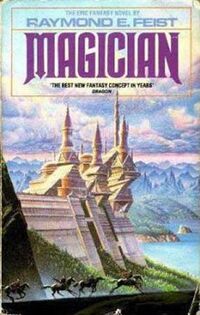
Last night I began again the novel Magician by Raymond E. Feist, having just finished the Daughter of the Empire trilogy he wrote with Janny Wurtsa trilogy set wholly in one of the two worlds of Magician, and partially overlapping the timeline of that story. A quote from a review of Magician by Dragon Magazine should give you a feel for how the book was received, way back in the early 80s:

"[Magician] is filled with new concepts and reworkings of familiar ones that comes off well enough to be embraced as new… more than a breath of fresh air  it is a sweeping sweet wind which has a chance of putting its author firmly on the throne next to Tolkien  and keeping him there."


The reason I'm reading Magician is because I have at long last decided to dust off a fantasy novel that I began twelve years ago, with the ridiculously long working title Em, and somewhat more substantial new title Armour of a Fallen God. I reached 100K words and reluctantly put it aside. It was my first attempt at a novel-length work, and in the course of writing it, I broke the first three pieces of advice given to the new writer:
  • Start small
  • Write from experience (I knew little about European forests and medieval mores)
  • Don't edit at the same time
I had reached 100K words and plot-wise was just getting going. But I desperately wanted some closure. I wanted to write and finish something. At that time I happened to read a collection of novellas by Stephen King (the collection is Different Seasonswhich, incredibly, even for an established author like King, was viewed as a risk by his publishers), and was reminded of the possibilities of short formats. So I put the fantasy novel aside, and wrote short stories… and thereby broke the fourth piece of advice given to the new writer:
  • Whatever you do, don't start another project at the same time
From that time I stopped reading the fantasy genre, despite the fact that it had first fired my reading urgeThe Hobbit, LOTR, Magician and the other books of the Riftwar Saga, The Belgariad, The Dragonlance Chronicles… I stopped cold turkey, because I knew that if I read the genre, I would want to write it.

I've been trying to crystallise what it is about the fantasy genre that is so morish. What is the essence of fantasy? Well, I don't know about essence, but part of its appeal for me is how the story being told lives and breathes in an atmosphere of many other, untold stories. This struck me last night as I opened the pages of Magician and read of the young protagonist, Pug, who is caught in a ferocious storm but fears seeking shelter in the dark forest glades because of "remembered tales of outlaws and other, less human, malefactors…" The half-heard myths and histories of LOTR are surely a large part of its appeal. 

The fantasy writing of Lewis and Tolkien was scorned as escapist literature, but they regarded fantasy as a different way of talking about real life, in a guise that, because fantastic, sneaks under our defences. G.K. Chesterton sums this up nicely: "Fairy tales do not tell children the dragons exist. Children already know that dragons exist. Fairy tales tell children the dragons can be killed."

Well, given the lines from the Dragon Magazine review (written in the 80s, note), it seems a difficult prospect to write a fantasy novel that is new enough to avoid being cliched, but familiar enough to provide that delicious sense of recognition. Here goes…

Wednesday, 6 February 2013

Storyteller: The Life of Roald Dahl


I find I read biographies with the same bad habit that afflicts my daily life--a readiness to judge a person in the whole based on an instance of behaviour or speech. It's an entrenched habit that only grace will erode (but that's another story).

In the case of Donald Sturrock's "Storyteller: The life of Roald Dahl" that bad habit could lead to neurological trauma. Let me explain…

If it's a biography's job to distil the essence of man, his life, almost as an argument made, then this book fails. Because when I turned the final page, what it left me was not a thesis but a coin. Flip it once, it lands with a smiling Dahl--philanthropist, children's advocate, gifted storyteller; flip it again, it lands with a frowning Dahl--bully, provocateur, gifted "storyteller"… page after page, paragraph after paragraph, filled with contradictions.

Clearly my definition of biography is broken, because it's a great biography.

Dahl's life was full. You could remove his writing entirely, and still have a job selecting material. Hijinks at Repton (a school that could have been model for Tom Brown's School Days); fighter pilot--crash landed in North Africa before his first mission, recuperated in time to take part in World War Two's debacle at Greece, and finally invalided home with a twisted spine that would inflict him for life; socialite who mixed with presidents, movie makers, magnates, writers, spies; grieving family man who, in rapid succession, endured the death of his first daughter, and disablement of his son then wife.


In the end, it left me profoundly sad. Biographies often do that to me, with their rapid sweep through a person's life. Toddler photos in particular get me--the eyes that look at you without an inkling of what joys and griefs the next three hundred pages will record. The mixture of brokenness and joy of this complex man, and the sense that beneath an exterior often so sure, there lurked the confused and hurting child. I don't think he was alone in that.

With grim irony Sturrock records that Dahl's second last utterance was to tell his daughter, Tessa, that he loved her very much, thus healing a longtime rift.

His very last, in response to a needle prick, was an expletive.

Sunday, 20 January 2013

The Superman and the Sea


I must be on a bit of a Hemmingway kickhe says wondering what a full-blown case of Hemmingway-itis would look like. Maybe…

(Around the breakfast table)
Me: Have you eaten enough?
Child #1: Lamentably no. My gastronomic rapacity knows no satiety.
Me: If I've told you once, I've told you twice, don't use ten-dollar words. There are older and simpler and better words.

Or perhaps just a desire to rub hair tonic into one's balding pate. (As reported of Hemmingway by Roald Dahl, who was wondering what was taking the old guy so long.)

Okay, I got off track there. This post was supposed to be a brag about the fish I caught in Denmark (the town, not the country), and a speculation about the reason for this marine feat.

First, the brag. Here's the fish. It's a whiting, but I'm not sure if its of the king george or yellow-fin variety (yes, I'm aware it has yellow fins). You can call me Ishmael.


Second, the speculation. A day before we travelled to Denmark I had a little-performed blood test that involved the drawing, irradiation, and re-injection of blood. I haven't received the results, but isn't it obvious? Blood plus radiation can have only one outcome: super powers. To wit, the fish. I have obtained some kind of fish mastery.

PS: The hand captured in the photo above belongs to a very tall native of Denmark (the country, not the town), who goes by the name of Ruprecht. He has a hand-span the size of a hubcap.

Saturday, 5 January 2013

Free book, dude.

Dark Matter free today.

...working on a guest post for FreeBookDude.com, topic: what I like in a novel. What elements make a novel enjoyable for you?

Wednesday, 2 January 2013

Is a first draft like a first bullet?

Just finished the first draft of a detective novel, tentatively titled Strawman Made Steel. Needless to say I feel a mixture of elation and exhaustion. (And hunger, but that could just be normal.)

Tonight's editing only involved patching up the odd hole, marked in the manuscript by the very descriptive ??. The last ?? I had to patch was a reference to George Orwell's description of what it was like to be shot.


I leave you with an excerpt, and a link to the full passage. It's fascinating.

There seemed to be a loud bang and a blinding flash of light all around me, and I felt a tremendous shock - no pain, only a violent shock, such as you get from an electric terminal; with it a sense of utter weakness, a feeling of being stricken and shriveled up to nothing.
 Sounds a bit like finishing a first draft. You know the pain is coming... ;-)


Monday, 31 December 2012

Literary taste


Every so often a document comes past my inbox listing responses by famous people to the question: Why did the chicken cross the road? You've probably seen it. (The list, not my inbox.)

For example, in response to, Why did the chicken cross the road?
Ernest Hemmingway says: To die. In the rain.


There is no response (that I've found) for the author Saul Bellow. If there were, I imagine it might go something like:
I am a Leghorn, Worcester born--Worcester, that somber city--and go at things, such as this tar-stain black of tarmac, as I have taught myself, free-style, one leg after the other, high on drumstick, and will make the record my own way: first to scratch, first to worm; sometimes an innocent scratch, sometimes a not so innocent. But a chicken's character is her fate, says old man Sanders… etc. etc.

You couldn't find a starker contrast of language use. Words for Hemmingway are pebbles in his hand, the smaller the better; words for Bellow are liquid, and each novel an ocean.

Very different. But you know what? Both authors are represented in Time's Best 100 Novels (1923-2005).

PS: Hemmingway worked hard to achieve his pared down style. In this he was helped by his wife, Elizabeth Hadley Richardson, who, upon the request of her husband, packed all of his papers--everything she could find, including carbon copies--into a suitcase, which promptly disappeared from the station platform while Hadley was purchasing a bottle of Evian for the trip.

And this was before any of Hemmingway's fiction had been published.

I have a theory that it was Mrs. Bellow that mistakenly took the Hemmingway suitcase.